

Orchid Island Real Estate: What You Need to Know About Florida's Most Private Oceanfront Address
If you've spent any time researching Florida's ultra-luxury coastal market, you've probably come across Orchid Island — and wondered why it doesn't get more attention. The answer is simple: the people who know about it prefer it that way.
Orchid Island sits at the northern tip of Indian River County, just south of the Brevard County line. It's a barrier island in the truest sense — narrow, gated, and bounded by the Atlantic Ocean on one side and the Indian River Lagoon on the other. There's no commercial strip, no chain restaurant, no shortcut traffic. There's just one road in and one road out, and a gate that separates the island from everything else.
This post is a comprehensive look at what makes Orchid Island one of Florida's most compelling oceanfront real estate markets — the geography, the architecture, the value drivers, and what serious buyers need to understand before pursuing a property here.
What and Where Is Orchid Island?
Orchid Island is an unincorporated barrier island community located in northern Indian River County, Florida [1]. The town of Orchid itself is one of Florida's smallest municipalities, with a population well under 500 permanent residents [2]. Despite sitting just south of the Sebastian Inlet — which forms the natural boundary between Indian River and Brevard counties — Orchid Island draws buyers and brokers from the entire Space Coast corridor.
The island's geography is its defining feature. The Atlantic Ocean runs along the eastern shore. The Indian River Lagoon — a federally designated estuary of national significance [3] — wraps around the western side. On a barrier island this narrow, nearly every parcel benefits from either direct ocean frontage, lagoon views, or both. That ocean-to-river relationship is rare even by Florida standards, and it's a primary reason that Orchid Island real estate commands the prices it does.
The Barrier Island Setting: Why Geography Drives Value
In Florida coastal real estate, the phrase "barrier island" carries real weight. Barrier islands act as natural buffers between the open ocean and the mainland, which makes waterfront living on them feel genuinely removed from everyday life [4]. But that same geography introduces important considerations — particularly around flood zones, insurance, and elevation.
Properties on Orchid Island fall within FEMA Special Flood Hazard Areas, typically Zone AE or Zone VE, depending on specific parcel location and proximity to the ocean [5]. Zone VE designations — the "coastal high hazard" classification — indicate areas subject to high-velocity wave action during storm events. This directly affects flood insurance requirements and building standards.
Under Florida's building code, structures in VE zones must meet strict requirements for foundation design, first-floor elevation above base flood elevation, and breakaway construction for enclosures below the lowest floor [6]. Buyers evaluating oceanfront estates in this area should commission an independent elevation certificate from a licensed surveyor and review the current FEMA flood map for the specific parcel. Flood insurance rates are determined by the National Flood Insurance Program (NFIP) and can vary significantly based on the structure's elevation relative to base flood elevation [5].
None of this is unique to Orchid Island — it applies across Florida's Atlantic and Gulf barrier island communities. But it's essential due diligence that no buyer at any price point should skip.
British West Indies Architecture: A Design Tradition Built for This Climate
The architectural style most associated with Orchid Island's premier estates is British West Indies — sometimes called BWI architecture. This is not a decorative trend. It's a design tradition developed over centuries in the Caribbean specifically to address tropical climate conditions: heat, humidity, intense sun, and the occasional severe storm.
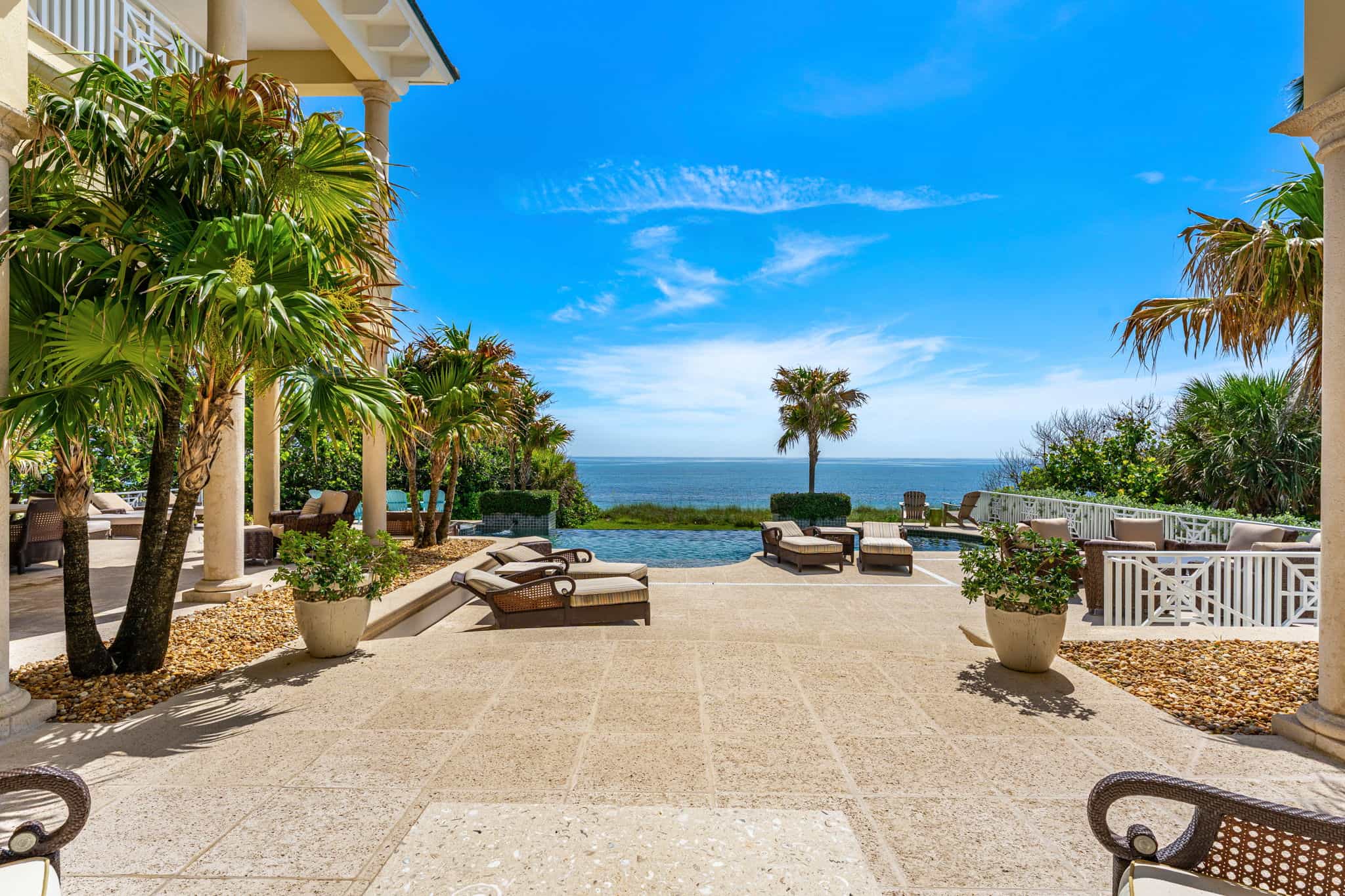
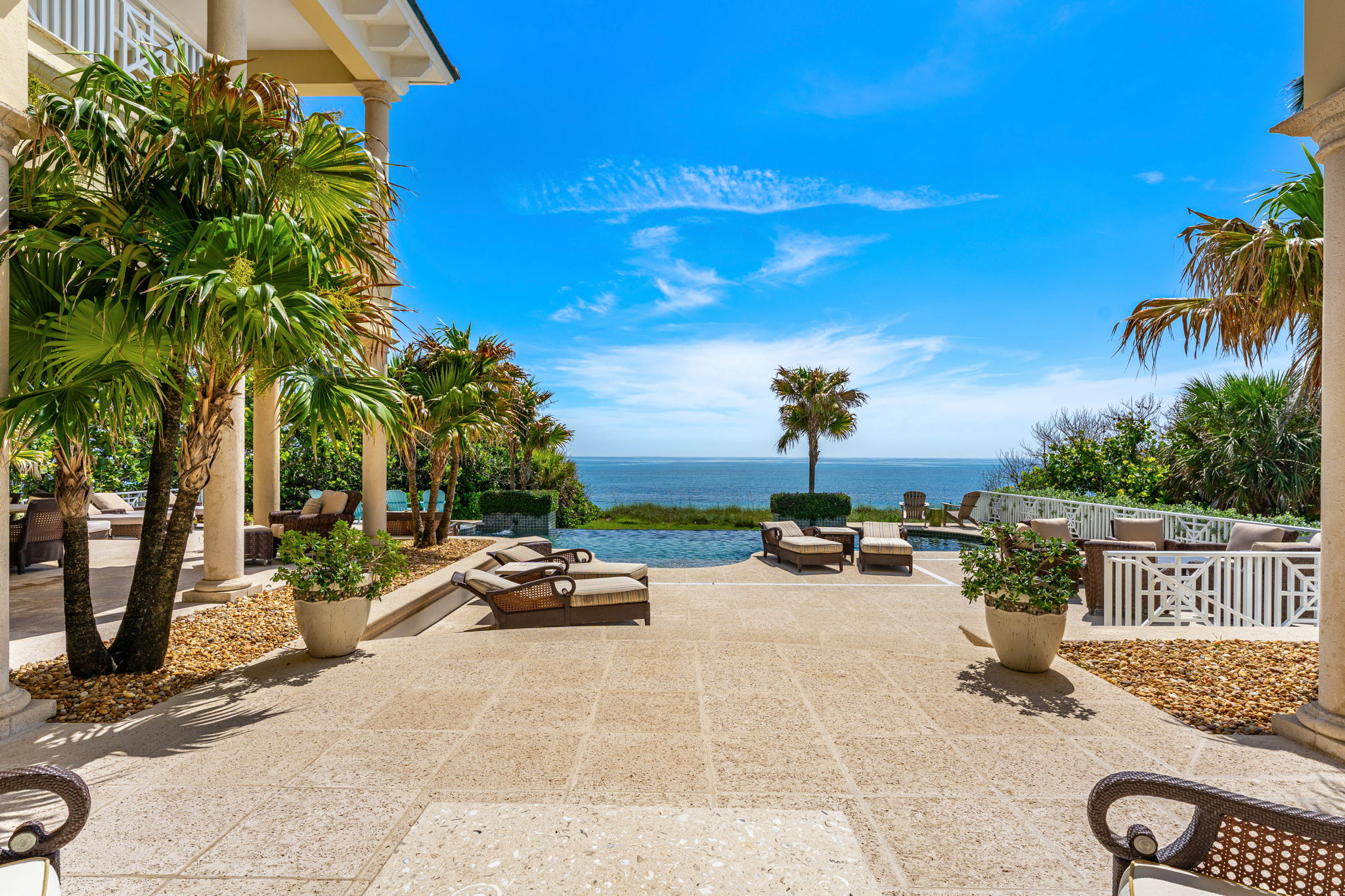
BWI architecture is characterized by steeply pitched metal roofs (which shed both rain and heat effectively), deep covered verandas and colonnaded arcades that provide shade while capturing prevailing breezes, coral or sand-toned stucco exteriors, jalousie shutters and louvered details, arched openings, and an emphasis on indoor-outdoor living through the use of loggia spaces and covered outdoor rooms [7].
In a Florida oceanfront context, these features solve real problems. Deep overhangs reduce solar heat gain through glazing. Covered outdoor living spaces — arcade-style verandas, summer kitchens under colonnade — extend usable living area into the outdoors for most of the year. The vertical orientation typical of BWI estates, with three-story massing set on elevated foundations, maximizes unobstructed ocean views while meeting elevation requirements.
When built at the estate scale with modern construction standards, BWI architecture also means impact-rated windows and doors, reinforced concrete construction, and hurricane-rated roofing systems — features that are non-negotiable in Florida's wind-zone coastal areas [6].
What Ocean Frontage Actually Means at the Estate Scale
Oceanfront is one of the most overused words in Florida real estate marketing. "Ocean view," "ocean block," "steps to the beach," and "ocean access" are all meaningfully different from direct Atlantic frontage. At the true estate level on Orchid Island, the distinction is measured in linear feet of shoreline.
Florida law places the mean high-water line as the boundary between privately owned upland property and state-owned submerged lands [8]. This means that while private landowners hold title to the upland beach area — including the dry sand and dune system — the wet beach and water itself remain state property. Buyers evaluating oceanfront parcels should carefully review the survey to understand exactly where the property boundary sits relative to the mean high-water line and the dune line.
Florida also has strict regulations governing coastal construction, dune alteration, and vegetation removal in the Coastal Construction Control Line (CCCL) zone, administered by the Florida Department of Environmental Protection [9]. Any modifications to structures, dunes, or native vegetation within the CCCL require a DEP permit. This includes pool construction, dune crossovers, walkovers, and seawall or revetment work. A private dune crossover — such as the kind that provides direct beach access on premier Orchid Island estates — must be permitted and constructed to DEP specifications.
The Indian River Lagoon: A Second Waterfront Asset
The lagoon side of Orchid Island is often an afterthought in the marketing conversation about oceanfront estates, but it shouldn't be. The Indian River Lagoon is one of North America's most biodiverse estuaries, spanning 156 miles along Florida's east coast [3]. It supports over 4,300 species of plants and animals, including the Florida manatee and the bottlenose dolphin [3].
For estate properties on the barrier island, the lagoon provides a second orientation — west-facing sunset views versus east-facing sunrise views from the ocean side — and in some cases navigable water access for vessels. The lagoon's protected, calmer water makes it more suitable for paddleboarding, kayaking, and light boating than the open Atlantic.
From a real estate value standpoint, ocean-to-river island parcels — those narrow enough that the estate sits between both bodies of water — are among the most coveted configurations in Florida coastal real estate. The cross-water breeze effect on a narrow barrier island is also measurable and appreciated in a climate where passive cooling matters.
Title, Property Rights, and Due Diligence at the Ultra-Luxury Level
Estate-level purchases in the $10 million-and-above price range require a level of due diligence that goes well beyond a standard home inspection. Here is what sophisticated buyers — and their legal and real estate teams — should verify before any oceanfront estate closing in this market:
Coastal Construction Control Line (CCCL) compliance. Every improvement on the property should have the appropriate DEP permits on file. Request permit history from the seller and verify with the Florida DEP [9].
Flood elevation certificate. An elevation certificate completed by a licensed surveyor documents the structure's elevation relative to base flood elevation. This document is essential for understanding flood insurance obligations and for accurately estimating NFIP premium costs [5].
Survey with mean high-water line delineation. The survey should clearly show the relationship between the property's upland boundary, the CCCL, and the mean high-water line. In some cases, ongoing beach erosion or accretion can shift these relationships over time [8].
Wind mitigation inspection. Florida's residential wind mitigation inspection documents construction features — roof covering, roof deck attachment, roof-to-wall connections, opening protections — that directly affect wind insurance premiums [10]. For a concrete-and-impact-glass estate, wind mitigation credits can be substantial.
HOA documents and gate community covenants. In a gated barrier island community, the HOA documents govern architectural standards, use restrictions, assessment obligations, and access rights. Under Florida Statute 720, buyers have a right to receive and review HOA documents prior to closing [11].
Homeowners insurance. Florida's property insurance market has undergone significant upheaval. Several major insurers have reduced or eliminated their Florida exposure [12]. At the estate level, coverage is typically placed through surplus lines carriers or Lloyd's of London syndicates rather than admitted carriers. A licensed Florida property insurance broker with experience in high-value coastal placements is essential, not optional.
Understanding the Orchid Island Market in Context
Orchid Island occupies a specific niche in the Florida luxury coastal hierarchy. It is not Palm Beach. It is not Fisher Island. It is not the Ritz Carlton corridor of Sarasota. That's precisely the point for buyers who value genuine privacy, barrier island geography, and low density over celebrity adjacency or resort-district amenity.
The town of Orchid's year-round population of under 500 residents [2] means that even at full occupancy during peak season, the island retains a quietness that larger luxury communities cannot offer. There are no commercial properties on the island. There are no vacation rental compounds or short-term rental operations at scale. The gated entry controls access for the entire island, not just individual estates.
For comparison, the broader Treasure Coast and Space Coast luxury corridor — encompassing Vero Beach, Sebastian, Melbourne Beach, and Orchid — has seen sustained demand for oceanfront inventory even as broader Florida markets have cycled. Florida Realtors data shows that Indian River County's median sale price for single-family homes has risen materially over the past several years, reflecting the sustained in-migration of buyers from higher-cost northeastern and midwestern metros [13]. Ultra-luxury oceanfront estates, by virtue of their scarcity, tend to decouple from broader median price trends — supply is effectively fixed.
Working with a Broker Who Knows This Market
Estate-level oceanfront transactions are not commodity real estate. The due diligence is layered. The insurance landscape is complex. The regulatory framework — CCCL, FEMA, Florida building code, HOA covenants — requires a broker who can identify the right questions and connect buyers with the right specialists: environmental attorneys, licensed surveyors, surplus lines insurance brokers, and Florida-licensed engineers.
MaxxCity Realty serves clients throughout Florida's Space Coast and Treasure Coast, combining innovative marketing technology with personalized service and experience managing complex real estate transactions. Whether you're exploring an oceanfront purchase, preparing to sell, or simply seeking insight into today's luxury market, we're here to provide thoughtful guidance and a tailored marketing approach.
Reach out to discuss available properties, upcoming opportunities, or the current value of your oceanfront home. All conversations are confidential, and private inquiries are always welcome.
Sources
- [1]Indian River County Board of County Commissioners — https://www.ircgov.com
- [2]U.S. Census Bureau — American Community Survey, Town of Orchid, FL — https://www.census.gov/quickfacts/orchidflorida
- [3]Indian River Lagoon National Estuary Program — https://www.epa.gov/national-estuary-program/indian-river-lagoon-comprehensive-conservation-and-management-plan
- [4]NOAA Office for Coastal Management — Barrier Islands — https://coast.noaa.gov/states/fast-facts/barrier-islands.html
- [5]FEMA National Flood Insurance Program — https://www.fema.gov/flood-insurance
- [6]Florida Department of Business and Professional Regulation — Florida Building Code, Coastal Construction Standards — https://www.floridabuilding.org
- [7]Florida Department of State, Division of Historical Resources — Architectural Styles of Florida — https://dos.fl.gov/historical/
- [8]Florida Department of Environmental Protection — Mean High Water Line and Coastal Property — https://floridadep.gov/water/submerged-lands-environmental-resources-coordination
- [9]Florida Department of Environmental Protection — Coastal Construction Control Line Program — https://floridadep.gov/water/beaches-coastal-systems/content/coastal-construction-control-line-permitting
- [10]Florida Department of Financial Services — Wind Mitigation Inspections — https://www.myfloridacfo.com
- [11]Florida Statute 720 — Homeowners' Associations — https://www.leg.state.fl.us/statutes/index.cfm?App_mode=Display_Statute&URL=0700-0799/0720/0720.htm
- [12]Florida Office of Insurance Regulation — https://www.floir.com
- [13]Florida Realtors — Market Statistics — https://www.floridarealtors.org/tools-research/reports/florida-market-statistics
- [14]Disclaimer - Market/ Rate / Commission claims are general information and not financial advice.